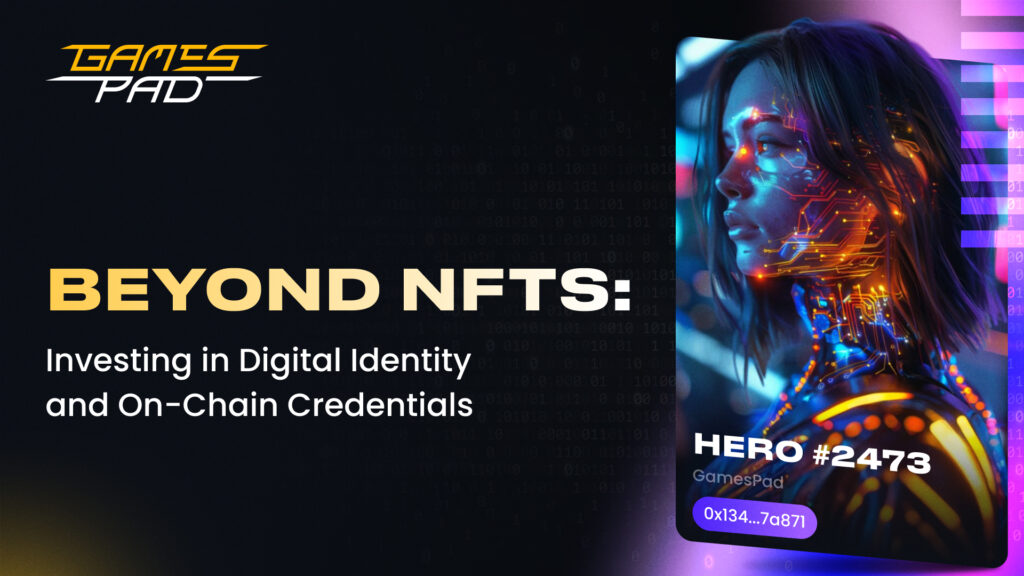
In the early stages of the Web3 movement, non-fungible tokens (NFTs) dominated headlines as speculative art and collectible assets. But as the market matures, investors are increasingly shifting their focus from digital artwork and profile pictures to a deeper, more consequential concept—digital identity. At the core of this shift lies a growing recognition that digital identity and on-chain credentials could become foundational layers of the decentralized internet.
Unlike NFT speculation, identity-focused Web3 projects are targeting long-term utility: trusted authentication, reputation systems, access control, and verified credentials. Venture capital firms, institutional players, and even governments are now exploring this sector, not just for its disruptive potential but for its necessity in a fully functioning digital economy.
In Web2, identity is fragmented, custodial, and vulnerable. Users create dozens of accounts across platforms, often tied to centralized databases managed by corporations. Every login is another point of risk, and every data breach reveals how exposed individuals truly are. Worse, users do not own their data—platforms do. They monetize identity, preferences, and behavioral data without meaningful user control or compensation.
From a business standpoint, identity in Web2 is both a liability and a competitive moat. Firms are reluctant to share user data, even at the cost of interoperability or user convenience. As a result, identity verification is duplicated across services, compliance becomes expensive, and fraud prevention remains reactive.
This fractured system simply doesn’t scale into the future. A decentralized web demands a different model—one where users control their identity, credentials are portable, and verification is trustless and efficient.
In a Web3 context, digital identity is not just a wallet address or an NFT—it’s a composite profile built on-chain through user actions, verifiable credentials, and decentralized identifiers (DIDs). It includes social reputations, attestations, proof of humanity, access rights, and contributions across decentralized applications (dApps).
Digital identity projects aim to answer a fundamental question: How can someone prove who they are—or what they’ve done—without relying on a central authority?
Solutions like Soulbound Tokens (SBTs), Verifiable Credentials (VCs), and Zero-Knowledge Proofs (ZKPs) are leading the way. Together, they enable identity systems that are privacy-preserving, interoperable, and user-controlled.
On-chain credentials go beyond static identities to include achievements, affiliations, and trust scores. For example, a user might hold verifiable credentials showing that they’ve completed a course, contributed to an open-source project, or held a DAO governance role. These credentials are not transferable like NFTs; they are bound to a specific identity, much like academic degrees or professional licenses.
On-chain credentials help establish reputation in trustless environments. In a DAO, for instance, a governance participant with a history of responsible proposals and engagement may carry more weight than someone with newly acquired tokens. In decentralized hiring, credentials could validate a candidate’s skills or past work, cutting out the need for background checks or LinkedIn endorsements.
This ability to verify actions and attributes in a cryptographically secure, tamper-resistant way has clear implications for sectors ranging from finance to education to the gig economy.
The early NFT craze caught VC attention because of rapid growth, but the digital identity sector is drawing capital for a different reason: infrastructure. Identity is not a trend—it’s a requirement. Every decentralized protocol, dApp, or DAO will need a robust identity layer to scale.
Investment is flowing into:
These protocols aren’t consumer-facing gimmicks; they’re infrastructure investments with potential to underpin the entire Web3 stack. For VCs, the long-term thesis is clear: whoever controls the identity layer controls user onboarding, access, compliance, and trust.
Digital identity is no longer a hypothetical concept. Real-world pilots are already proving its relevance.
These use cases reinforce the idea that Web3 isn’t just about tokens—it’s about creating a digital society with reliable, interoperable identity as its bedrock.
For digital identity to succeed, it cannot be siloed. The future lies in interoperable frameworks that work across blockchains, apps, and devices. That’s why VCs are backing projects aligned with open standards and collaborative ecosystems.
Cross-chain compatibility, adherence to standards like DIDComm and W3C Verifiable Credentials, and modular architecture are now prerequisites for funding. This ensures that identities and credentials created on one platform can be trusted and used on others.
It’s no longer a winner-takes-all scenario. Instead, we’re seeing growing cooperation between wallet providers, identity issuers, and verification protocols—much like how early internet protocols coalesced into global standards.
Despite the promise, the road ahead is not without obstacles.
These are solvable challenges, but they demand serious innovation, regulatory dialogue, and community alignment.
The investment thesis around digital identity and on-chain credentials is straightforward: in a decentralized internet, identity must be self-sovereign, portable, and verifiable. Whoever solves that puzzle lays the foundation for everything else—from DeFi and DAOs to the metaverse and beyond.
Venture capital is no longer chasing hype cycles. It’s targeting essential infrastructure, and digital identity is at the center of that shift. Whether through Soulbound Tokens, zero-knowledge credentials, or decentralized identifiers, this sector is quietly building the rails for the next internet.
NFTs may have started the conversation about ownership, but digital identity will determine who we are, what we’ve done, and how we interact in the Web3 world.

 Huobi Global
 Gate.io
 PancakeSwap
 MEXC Global